 EN
EN


Introduction: The Hidden Threat of Humidity
In industrial environments such as coastal ports, water treatment plants, and offshore platforms, humidity is more than just a discomfort—it is a silent destroyer of electrical infrastructure. While a dry factory might operate for decades without a glitch, a high-humidity site can see critical component failure in a matter of months if the wrong materials are used.
Electrical failures in these environments typically stem from two sources: Corrosion and Insulation Breakdown. For B2B procurement officers and facility engineers, understanding how to mitigate these risks is vital for maintaining operational continuity and safety.
1. The Impact of Humidity and Salt Spray on Conductivity
Water is a conductor, and when air is saturated with moisture, it creates a conductive film over surfaces. In coastal regions, this is exacerbated by salt spray (saline mist). Salt ions significantly increase the conductivity of moisture, leading to:
- Creepage and Arcing: Moisture on the surface of insulators can allow electricity to "crawl" across, leading to short circuits and fire hazards.
- Galvanic Corrosion: When two different metals meet in the presence of moisture, one will corrode the other. This often happens at terminal connections, leading to high resistance and overheating.
- Oxidation: Copper wires and contacts can oxidize (turn green), which drastically reduces their ability to conduct electricity, causing power drops and equipment malfunction.
2. Material Selection: PC vs. Stainless Steel
When selecting distribution boxes and enclosures for high-humidity areas, the choice of material is your first line of defense.
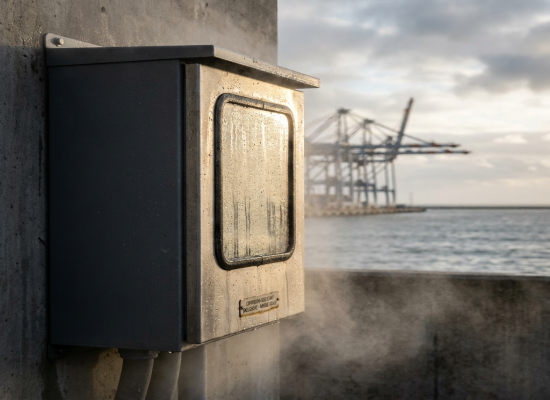
Reinforced Polycarbonate (PC)
For many marine and chemical applications, high-grade PC is actually superior to standard steel.
- Corrosion Immunity: PC cannot rust. It is naturally resistant to salt spray and many acidic environments.
- Mingtuo's Advantage: Our distribution boxes use UV-stabilized, high-impact Polycarbonate that maintains its structural integrity even under constant exposure to moisture and sunlight.
Stainless Steel (304 vs. 316 Grade)
If a metal enclosure is required for structural reasons, 316-grade stainless steel is the industry standard for marine environments due to its molybdenum content, which provides superior protection against "pitting" corrosion compared to 304-grade.
3. Advanced Sealing Techniques: IP66 and Beyond
The Ingress Protection (IP) rating is the most reliable metric for humidity resistance. For high-humidity sites, an IP65 or IP66 rating is usually the minimum requirement.
- Continuous Gasketing: High-quality enclosures use "poured-in-place" polyurethane gaskets. Unlike glued-on rubber strips, these form a seamless, airtight seal that doesn't peel or crack over time.
- Pressure Equalization Vents: Paradoxically, a perfectly sealed box can "breathe" in moisture. When the internal temperature drops at night, a vacuum is created, sucking in moist air through the tiniest gaps. Breathing vents allow air pressure to equalize while blocking liquid water and dust.
4. Protecting the Internals: Circuit Breakers and Connections
It is not enough to have a waterproof box; the components inside must also be protected.
- Tropicalized Components: Some circuit breakers are "tropicalized," meaning their internal metal parts are specially coated to resist mold and corrosion.
- Sealed Terminals: Using high-quality cable glands is non-negotiable. A cable entry point is the most common failure site. Mingtuo’s PG and M-series cable glands ensure that the IP rating of the box is maintained at the cable entry point.
- Dielectric Grease: Applying specialized grease to connections can provide an extra layer of moisture displacement for critical sensors and power links.
5. Case Study: Port Terminal Power Distribution
A major port in Southeast Asia faced frequent outages in their lighting and crane power systems due to the combination of 90% humidity and heavy salt mist. The previous metal enclosures were showing significant rust within 18 months.
The Solution: They transitioned to Mingtuo’s MT-series High-IP Plastic Distribution Boxes equipped with internal MTM1 MCCBs.
The Result: After three years of operation, the internal components show zero signs of oxidation, and maintenance-related downtime has decreased by 75%.
Conclusion: Investing in Longevity
Preventing electrical failure in high-humidity environments requires a shift from "lowest-cost" to "lowest-total-cost-of-ownership." While corrosion-resistant materials and high-IP enclosures may have a higher upfront cost, they pay for themselves many times over through reduced maintenance and the avoidance of catastrophic failure.
At Mingtuo Electric, we specialize in "harsh environment" solutions. From our waterproof industrial socket boxes to our sealed distribution systems, we provide the durability your critical infrastructure demands.
Table of Contents
- Introduction: The Hidden Threat of Humidity
- 1. The Impact of Humidity and Salt Spray on Conductivity
- 2. Material Selection: PC vs. Stainless Steel
- 3. Advanced Sealing Techniques: IP66 and Beyond
- 4. Protecting the Internals: Circuit Breakers and Connections
- 5. Case Study: Port Terminal Power Distribution
- Conclusion: Investing in Longevity