 EN
EN


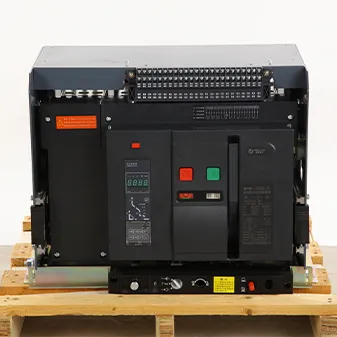
In the design of large-scale industrial and commercial power systems, the choice between an Air Circuit Breaker (ACB) and a Molded Case Circuit Breaker (MCCB) is one of the most consequential decisions an electrical engineer or project manager will make. While both serve the fundamental purpose of circuit protection, they operate on different scales of power, complexity, and durability.
For B2B procurement professionals, understanding the technical boundary between these two devices is essential for optimizing both system safety and project budget.
Defining the Contenders: ACB vs. MCCB
What is an MCCB?
A Molded Case Circuit Breaker (MCCB) is a compact device where all components are enclosed in a molded housing of insulating material. They typically handle currents from 15A up to 2500A and are widely used for feeder protection and motor control.
What is an ACB?
An Air Circuit Breaker (ACB) is an open-frame breaker that uses air as the arc quenching medium. ACBs are the heavyweights of the electrical world, designed for high-current applications—ranging from 400A to 6300A. They are typically found at the main incoming side of low-voltage switchgear.
The Technical Deep Dive: Key Differences
1. Breaking Capacity and Short-Time Withstand (Icw)
One of the most critical differences is the Short-Time Withstand Current (Icw).
- ACB Advantage: ACBs are designed to withstand high fault currents for a specific duration (e.g., 1 second) without tripping. This allow downstream breakers (MCCBs) to clear the fault first, ensuring "Selectivity" or "Discrimination." This prevents a small fault in one branch from shutting down the entire facility.
- MCCB Limitation: MCCBs are generally "current limiting." They trip as fast as possible to protect the downstream cable. While efficient, they offer less flexibility for system-wide selectivity at high current levels.
2. Maintenance and Longevity
- ACB: Designed for a long service life (20+ years) with regular maintenance. The contacts can be inspected, and the arc chutes can be replaced. Most ACBs are "Draw-out" type, allowing for easy removal and testing without disconnecting the main busbars.
- MCCB: Generally considered maintenance-free but also "non-repairable." If an MCCB fails or reaches the end of its electrical life after a major fault, the entire unit is replaced.
3. Intelligence and Customization
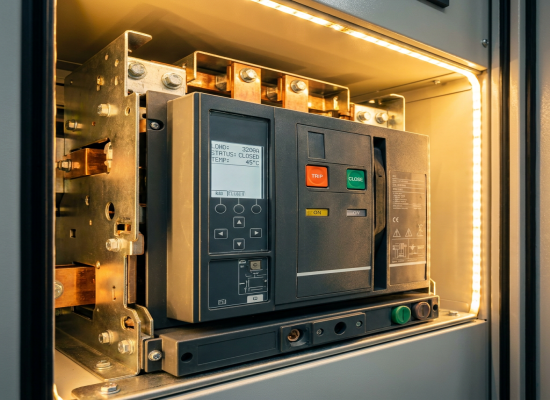
Modern ACBs, like the Mingtuo MTW1 series, come equipped with sophisticated electronic trip units (Microprocessor-based). These units offer:
- Real-time power quality monitoring (Harmonics, Voltage, Frequency).
- Communication protocols (Modbus, Profibus) for integration into SCADA systems.
- Adjustable LSI (Long, Short, Instantaneous) settings with high precision.
When to Use Which? The Selection Matrix
|
Feature |
MCCB |
ACB |
|
Current Range |
Up to 2500A |
400A to 6300A |
|
Common Application |
Branch/Feeder Protection |
Main Incomer / Bus Coupler |
|
Mounting |
Fixed / Plug-in |
Fixed / Draw-out |
|
Selectivity |
Limited |
High (due to Icw) |
|
Maintenance |
None (Replace) |
Regular (Inspect/Repair) |
|
Cost |
Lower |
Higher |
The "Overlapping Zone" (400A - 2000A)
In the 400A to 2000A range, both MCCBs and ACBs are viable.
- Choose MCCB if space is limited and the primary goal is cost-effective branch protection.
- Choose ACB if the breaker is the main incomer, or if system continuity is critical (requiring full selectivity).
Mingtuo’s Solutions for High-Current Systems
As a leading Chinese manufacturer, Mingtuo Electric provides a comprehensive range of both MCCBs and ACBs, ensuring a one-stop-shop for distribution board builders.
Mingtuo MTW1 Series ACB (Up to 6300A)
Our MTW1 series is engineered for the most demanding environments. Available in 3-pole and 4-pole configurations, it features:
- High breaking capacity (up to 120kA).
- Flexible draw-out design for minimum downtime.
- Optional intelligent controllers for smart grid integration.
Mingtuo MTNSX Series MCCB
For downstream protection, our MTNSX series offers the reliability of high-end MCCBs with the affordability of Chinese manufacturing excellence.
Strategic Sourcing: Why Delivery Speed Matters
In large infrastructure projects, delays in receiving the main ACB can stall the entire commissioning phase. Mingtuo maintains a robust inventory and an agile production line, allowing us to deliver customized ACBs in significantly shorter lead times than many Western brands, without compromising on IEC or CE standards.
Conclusion
The choice between ACB and MCCB is a balance of current requirements, selectivity needs, and maintenance strategy. By understanding these technical nuances, B2B buyers can ensure they are providing the most reliable and cost-optimized protection for their power systems.
Unsure which breaker is right for your project?
[Contact Mingtuo’s technical team](https://www.mingtuo-electric.com) for a detailed protection coordination study and quotation.